Union Jack – The flag of the United Kingdom of Great Britain and Northern Ireland
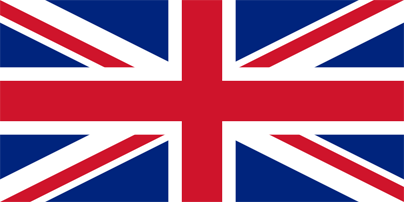
The flag of the United Kingdom of Great Britain and Northern Ireland is a combination of more flags.
It is known as Union Jack although it is often stated that the Union Flag should only be described as the "Union Jack" when flown in the bows of a warship.
There is also the theory that the name Union Jack came from King James, whose name is ›Jacobus‹ in Latin, and ›Jacob‹ in Hebrew.
1. The parts of the flag
1.1. St George's Cross (England)
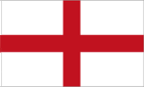
In 1194 A.D., Richard I of England introduced the Cross of St. George, a red cross on a white ground, as the the national flag of England until James I succeeded to the throne in 1603.
1.2. St Andrew's Cross (Scotland)
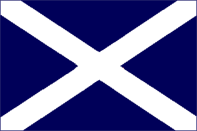
St Andrew, brother of the Holy Petrus, converted Asian people to Christanity. He was executed on an askew cross. His body was brought to Scotland. In the 11th century St Andrew was claimed to be the only patron saint of Scotland. Since the 14th century Scottish troops have been carrying a white cross on a dark ground. In the 17th century the dark ground became blue.
1.3. St Patrick's Cross (Ireland)
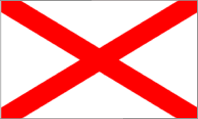
St Patrick, the Irish patron saint lived from about 385-461. His original name was Maewyn. He grew up in Wales. Later he was taken away to Ireland. 6 years later he flew to France and lived in a monstary for 12 years. He became a priest there and took over the name ›Patrick‹. He went to Ireland as a bishop. St. Patrick built monastries, churches and schools there. He became very popular. The origin of the flag goes back to 17th March (St. Patrick's Day). Since the 17th century people wear a cross made of paper on this day.
2. The form of the flag of the United Kingdom
|
+ | 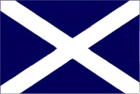 |
= | 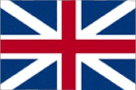 |
The first Union Flag was formed in 1606 (union with Scotland).
|
+ | 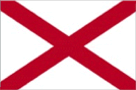 |
= |  |
After the Act of Union (1801) the St Patricks Cross was inserted into the existing flag of Great Britain (a flag composed of the English St George's Cross and the Scottish St Andrew's Cross) as a symbol of Ireland.