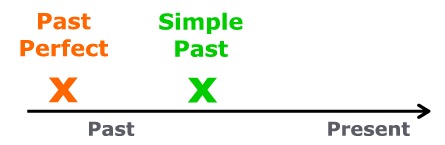
together with the Simple Past (When two past actions are combined – the first action, which was completed before the second one began, is put into Past Perfect.)
the past equivalent of the Present Perfect
action finished in the past
series of completed actions in the past
2. Signal words
Past Perfect
Simple Past
no unambiguous ones
yesterday
last week
a month ago
in 2010
3. Form
Past Perfect
Simple Past
had + past participle*
regular verbs: infinitive + ed
irregular verbs: 2nd column of the table of the irregular verbs
4. Examples
We use the the same form of the auxiliary (had) every time regardless the subject.
4.1. Affirmative sentences
Past Perfect
Simple Past
Long forms
He hadplayed hockey.
He played hockey.
Contracted forms
He'dplayed hockey.
not possible
4.2. Negative sentences
Past Perfect
Simple Past
Long forms
He hadnotplayed hockey.
He didnotplay hockey.
Contracted forms
He hadn'tplayed hockey.
He didn'tplay hockey.
He'dnotplayed hockey.**
** This form is rarely used.
4.3. Questions
Past Perfect
Simple Past
Had he played hockey?
Did he play hockey?
5. Spelling (Past Perfect and Simple Past)
stopped (Double the consonant after a short vowel.)
loved (one -e at the end of the word → Add only -d.)
worried (consonant before -y → Change to -i.)
* past participle:
regular verbs → infinitive + -ed
irregular verbs → 3rd column of the table of the irregular verbs